Last reviewed July 2026. This article is for education. It is not medical advice, and it is not intended to diagnose, treat, cure, or prevent any disease. Talk with your clinician before changing a supplement routine.
Folate shows up a lot in conversations about mood, and L-methylfolate (5-MTHF) is its active form. This guide explains the nutritional connection in plain terms, what the active form is, and the honest limits of what a supplement can do. It is education, not medical advice, and it is not a substitute for care from a clinician.
For the basics on the active form, see our L-methylfolate (5-MTHF) guide.
The nutritional link between folate and mood
Folate is one of the nutrients your body uses in the methylation cycle, which supports normal psychological function and the body’s own production of neurotransmitters. When folate is in short supply, or when a slow conversion step keeps synthetic folic acid from becoming usable, the body has less of the active form to work with. That is a nutritional gap, not a diagnosis, and filling a genuine gap is different from treating a condition.
Why the active form matters here
Folic acid is synthetic and has to be converted before your body can use it. L-methylfolate is already active. For the many people who convert folic acid slowly, especially those with an MTHFR variant, the active form is a more reliable way to get usable folate. See methylfolate vs folic acid for the full comparison.
What a supplement can and cannot do
Here is the honest part. A folate supplement supports normal nutritional status. It does not treat, cure, or prevent depression or any other medical condition, and it is not a replacement for professional care. If your mood is affecting your daily life, the most important step is to talk with a clinician, who can look at the whole picture, including whether nutrition plays any role for you.
Who is most likely to be low in active folate
- People with an MTHFR variant that slows folic-acid conversion
- People on restricted or low-variety diets
- People with certain absorption issues
Only a clinician can tell you whether this applies to you, and testing can help.
What the evidence does and does not say
Researchers have studied folate status in relation to mood for years, and active folate has been examined as a nutritional factor alongside professional care in some clinical settings. The honest summary: folate is genuinely important for the systems that support normal psychological function, and correcting a real shortfall matters. That is different from claiming a supplement lifts mood on its own for everyone. Evidence is strongest for people who are actually low in usable folate, and weaker as a general pick-me-up for people who already have enough. Treat folate as one input among many, not a lever you pull for a guaranteed result, and let a clinician interpret what fits your situation.
Food folate versus a supplement
Before reaching for a bottle, it helps to know where folate comes from in the first place. The nutrient is abundant in leafy greens like spinach and kale, in legumes such as lentils and chickpeas, in asparagus, avocado, and citrus. Folate in whole food is already in natural forms your body handles well, which is one reason a diet rich in these foods is the foundation, not the supplement. So why do supplements come up at all? Two reasons. First, a lot of people simply do not eat enough of these foods consistently, and cooking can reduce the folate in them. Second, and more specific to this topic, the synthetic folic acid added to fortified breads and cereals is the form that depends on a conversion step, which is the exact step an MTHFR variant slows down. That is the gap an active-form supplement is meant to fill: not to replace a good diet, but to provide usable folate for people whose food intake is low or whose bodies convert the synthetic version poorly. The sensible order is food first, then the active form as a supplement if a real gap remains, decided with your clinician rather than assumed.
Lifestyle factors that support mood alongside nutrition
Nutrition is one piece. The basics still do the heaviest lifting, and they are worth getting right before or alongside any supplement.
- Sleep. Consistent, sufficient sleep affects mood more reliably than almost any supplement.
- Movement. Regular activity supports normal mood and energy.
- Daylight and routine. Morning light and a steady daily rhythm help.
- Connection and professional support. If mood is affecting daily life, talking with a clinician is the most important step, not a bottle.
How to take the active form
- Choose the active form, L-methylfolate (5-MTHF), not folic acid.
- Prefer a complete B-complex, since folate, B12, and B6 work together.
- Start at the labeled dose in the morning, with food.
- Loop in your clinician, especially if you take any medication.
Active folate, in a complete formula
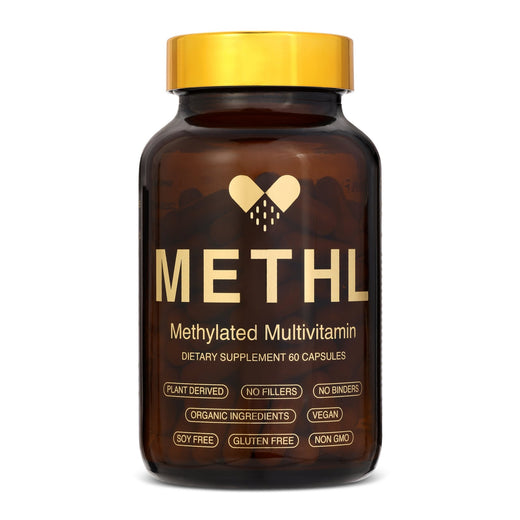
METHL delivers L-methylfolate and methylcobalamin together in a complete, third-party-tested B-complex, the active forms your body can use directly.
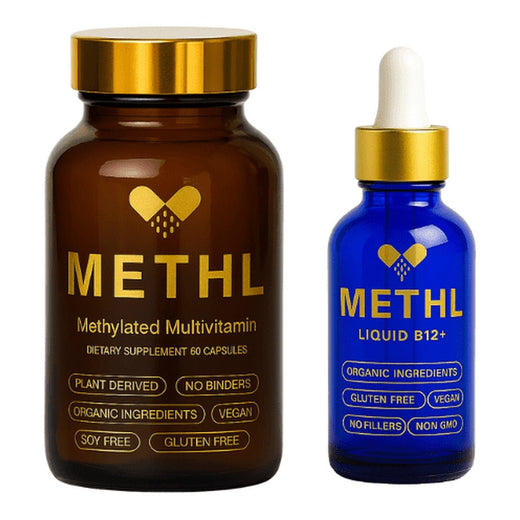
Shop the METHL Methylated Multivitamin See the Multivitamin + Liquid B BundleSigns your folate intake may be worth a look
None of these prove anything on their own, and all of them have many possible causes, so read this as a prompt to talk with a clinician, not a checklist to self-diagnose. People sometimes look into their folate status when they eat few leafy greens or follow a restricted diet, when they know they carry an MTHFR variant, when they have taken standard multivitamins for a long time without feeling any difference, or when a clinician has flagged elevated homocysteine on bloodwork. Any of these can be a reason to ask whether the active form of folate is worth trying as part of a broader plan. The evaluation belongs with your clinician, who can order testing if it makes sense and put the result in context with everything else going on.
How METHL approaches folate
We build our own formula around the active forms. We use L-5-MTHF for folate and methylcobalamin for B12, with active B6, so the nutrients that share the methylation cycle are all body-ready. We chose a balanced daily dose inside a complete formula rather than an isolated high-dose folate pill. See the methylfolate supplement and methyl B-complex collections.
The bottom line
Folate genuinely matters for the systems that support normal psychological function, and L-methylfolate is the active form your body can use directly, which is why it comes up in mood conversations. That is the honest ceiling of the claim: it is nutritional support, useful mostly for people who are actually low in usable folate, and it does not treat, cure, or prevent any condition on its own. Food comes first, the active form fills a real gap second, and professional care comes first of all if your mood is affecting daily life. If you and your clinician decide the active form is worth trying, choose L-5-MTHF over folic acid, take it in a complete B-complex at the labeled dose in the morning, and treat it as one input alongside sleep, movement, and support, not a lever that works on its own. Keep your expectations calibrated to what nutrition can do: it can remove a genuine shortfall as a limiting factor, which is worth doing, but it is not a substitute for care when care is what the situation calls for.
Keep reading
- L-methylfolate (5-MTHF) guide
- Methylfolate vs folic acid
- Best supplements for MTHFR
- Overmethylation symptoms
Frequently asked questions
Does l-methylfolate help with mood?
Folate supports normal psychological function and the body's production of mood-related neurotransmitters, and L-methylfolate is the active form. This is nutritional support, not a treatment for any condition. If you have concerns about your mood, talk with a clinician.
Is l-methylfolate the same as an antidepressant?
No. L-methylfolate is a nutrient, the active form of folate. It is not a medication and does not treat, cure, or prevent any medical condition. Discuss any medication questions with your clinician.
How much l-methylfolate should I take for mood support?
Follow the product label. Doses used in clinical settings vary and are decided by a clinician. For general nutritional support, the labeled dose in a complete formula is the place to start.
Can I take l-methylfolate with my medication?
Some nutrients interact with certain medications. If you take prescription medication, especially for mood or mental health, check with your clinician or pharmacist before starting.
Who is most likely to be low in active folate?
People with an MTHFR variant who convert folic acid slowly, people on limited diets, and some others. A clinician can evaluate this with you.
Sources: National Institutes of Health, Office of Dietary Supplements fact sheets on Folate and Vitamin B12 (ods.od.nih.gov). National Library of Medicine, MTHFR gene overview (medlineplus.gov/genetics). This article discusses nutrition and general wellness only. It does not address the diagnosis or treatment of any mental health condition. This article supports general wellness education and makes structure and function statements only. It does not diagnose, treat, cure, or prevent any disease.